
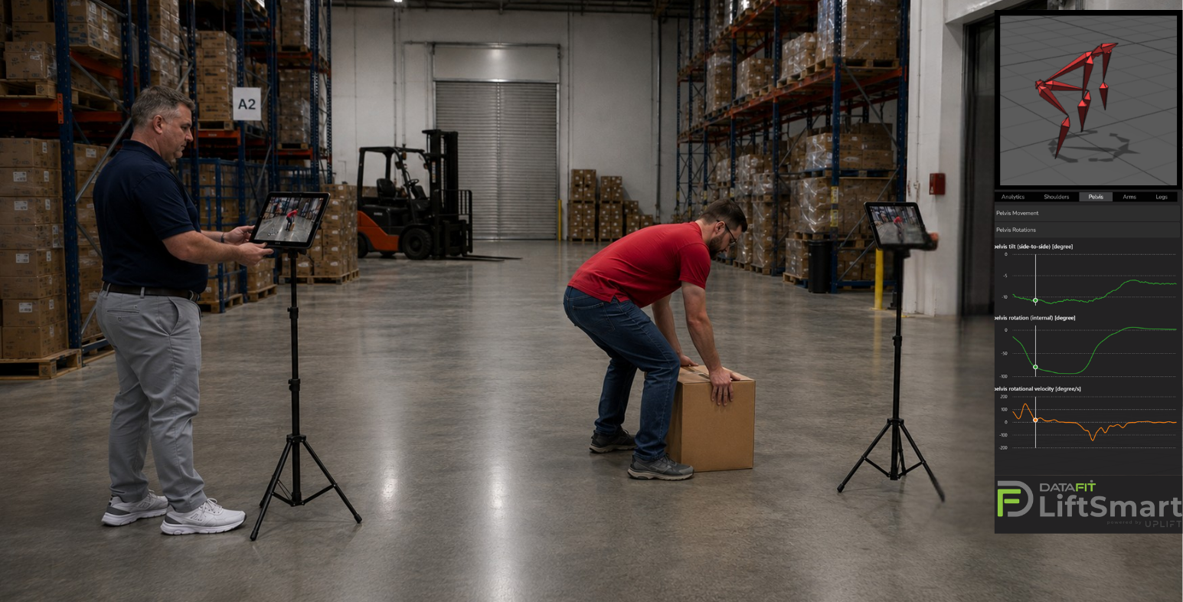
Ergonomic Futures: Forecasting the Next Decade of Workplace Wellness
For decades, workplace health and safety has largely focused on identifying hazards, evaluating ergonomic risk, and responding when an employee gets hurt. But the next decade will fundamentally change that approach.
The future of occupational health will not simply be about understanding the demands of a job. It will be about understanding the relationship between the demands of the job and the capabilities of the employee performing it, and continuously measuring how that relationship changes over time.
This is where DataFit and the LiftSmart Insight360 program are helping redefine what is possible.
From Ergonomic Risk to Workforce Capability
Traditional ergonomic assessments provide valuable information about the physical demands of a job. Physical abilities testing can then determine whether an individual can safely perform those demands.
But both are often treated as point-in-time assessments.
The next evolution is continuous insight into functional capability.
Imagine an organization that doesn’t just know the physical demands of a job or whether an employee can perform those demands at the time of hire. Instead, it has objective data showing how an employee’s functional capabilities change throughout their employment.
That creates an entirely different approach to occupational health and safety.
Physical Demands Analysis: Understanding the Job
The foundation starts with understanding the work itself.
Advanced technology can quantify the physical demands associated with specific jobs, including lifting, carrying, pushing, pulling, reaching, bending, twisting, squatting, and other functional requirements.
Rather than relying solely on subjective observations, organizations can build a more objective picture of what workers actually encounter in their jobs.
This creates a critical baseline:
What does the job require?
Physical Abilities Testing: Understanding the Worker
The next question is:
Can the employee safely perform those requirements?
Physical abilities testing provides objective information about an individual’s functional capabilities and can help organizations make better-informed decisions around placement, accommodations, return-to-work, and injury prevention.
But this is only one moment in time.
An employee’s physical capabilities are not static.
They can change because of age, training, workload, injury, recovery, fatigue, conditioning, or changes in the job itself.
That’s why the most significant opportunity may not be testing at the beginning of employment.
It may be what happens after the initial test.
The Future Is Ongoing Functional Capability Testing
This is where the LiftSmart Insight360 program can fundamentally change the way organizations think about employee health and safety.
Instead of viewing functional testing as a one-time event, organizations can begin creating an ongoing data set around workforce capability.
Repeated functional assessments can provide insight into how an employee’s capabilities are changing over time.
Are they improving?
Are they declining?
Are certain capabilities consistently trending downward?
Is there a measurable change following an injury?
Has an employee recovered to their previous functional baseline?
Is the physical demand of the job exceeding the worker’s current capabilities?
These are questions that traditional occupational health models often cannot answer objectively.
Turning Testing Into Intelligence
The real value isn’t simply collecting more data.
It’s what organizations can learn from the data.
When physical demands analysis, physical abilities testing, and ongoing functional capability data are brought together, organizations can begin developing a much more comprehensive understanding of their workforce.
Over time, this can reveal patterns that were previously invisible.
Organizations could identify relationships between job demands and declining functional capacity, recognize opportunities for intervention earlier, better understand recovery following injury, and develop more targeted strategies for workforce health and safety.
Instead of asking:
“Did this employee get injured?”
we can begin asking:
“What was changing before the injury occurred?”
Instead of asking:
“Can this employee perform the job today?”
we can ask:
“How has their functional capacity changed over the past year, and what does that tell us?”
That shift, from isolated testing to longitudinal insight, could be transformational.
AI and Data Will Change the Occupational Health Model
Artificial intelligence and advanced analytics will accelerate this transformation.
As organizations build larger longitudinal datasets, AI can help identify patterns across jobs, departments, facilities, and populations.
The objective isn’t simply to predict injuries.
It’s to better understand the complex relationship between the worker, the work, and changing functional capability. This could enable organizations to move from reactive occupational health strategies toward more proactive models built around measurable data.
The result is a workforce health strategy that is increasingly:
- Objective rather than subjective
- Proactive rather than reactive
- Continuous rather than point-in-time
- Data-driven rather than assumption-driven
- Personalized rather than one-size-fits-all
The Next Decade of Workplace Wellness
The future of occupational health and safety won’t be defined by one technology.
It will be defined by the ability to connect data.
Understanding the physical demands of the job.
Measuring the physical abilities of the worker.
Continuously monitoring functional capabilities.
And then turning all of that information into actionable intelligence.
DataFit and LiftSmart Insight360 are positioned to help organizations make that transition.
Because the future isn’t simply about knowing whether someone can perform a job.
It’s about understanding how their ability to perform that job changes over time, and using that insight to create healthier, safer, and more productive workplaces.
The organizations that embrace this shift will begin to see employee health and safety differently.
Not as a series of isolated tests, injuries, and interventions.
But as a continuous, measurable picture of workforce capability.
And that data could change the way we think about occupational employee health and safety for the next decade.

About the author
Philip Stotter, MS, CEP
Philip Stotter, MS, CEP has over 25+ years of experience in the medical, health, wellness, and professional sports industries. Clinician turned business developer, Philip is a sought-after industry speaker and professional consultant. His ground-breaking work in injury prevention, paired with the science of human movement, has put him at the forefront of product development with a multidisciplinary approach that integrates physiology, biomechanics, cutting-edge technologies, and data-driven research.