
Take Control of Occupational Testing: Your Data. Your Test. Your Technology.
For decades, organizations have relied on outside clinics, consultants, and third-party providers to evaluate the physical demands of work and assess whether an individual has the physical capabilities required to perform that work.
That model has its place.
But technology is changing what organizations can do for themselves.
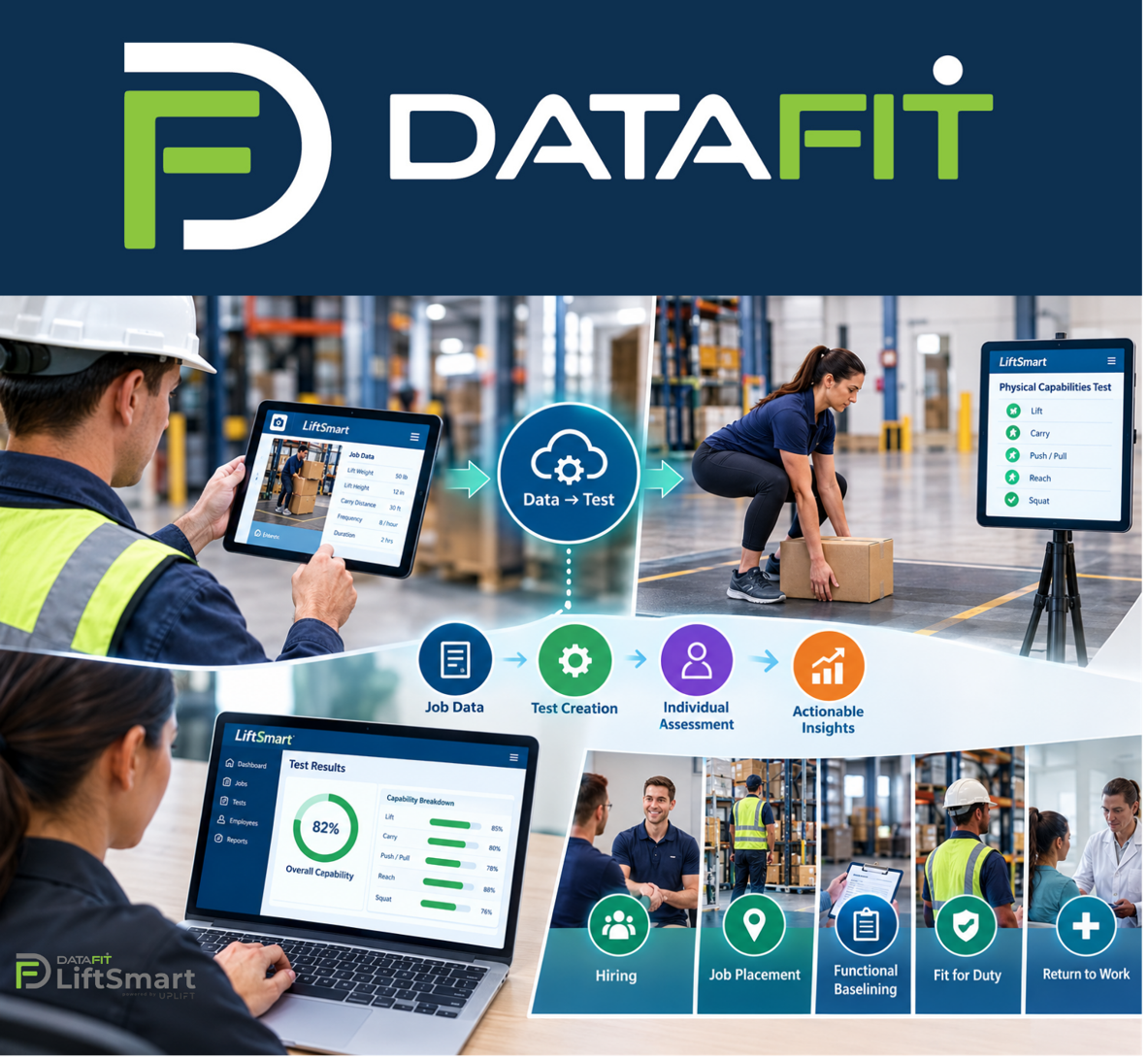
What if you could capture the physical demands of a job while the work actually happens, turn that data directly into a physical capabilities test, and use the resulting information across your workforce?
What if you didn't have to outsource every assessment?
What if the organization that knows the job best could collect the data, build the test, administer the assessment, and use the results to make better-informed workforce decisions?
That is exactly what we created with DataFit LiftSmart On-Demand Occupational Testing Technology.
Your data.
Your test.
Your technology.
You're in control.
Stop Guessing About the Job. Capture the Data.
A job description can tell you what an employee is expected to do.
But a job description doesn't necessarily tell you what actually happens on the floor.
In a material-handling environment, for example, "heavy lifting" could mean 30 pounds, 50 pounds, or 70 pounds.
It doesn't necessarily tell you:
- How much weight is being lifted
- Where the lift begins
- Where the load is placed
- How far the load is carried
- How frequently the task occurs
- How long the activity continues
- What other physical movements are required
- What the actual physical demands look like in the real work environment
That's where objective data becomes important.
Instead of relying exclusively on assumptions, outdated job descriptions, or subjective observations, organizations can capture information about the actual work and use that information to define the physical requirements of the job.
This creates a more meaningful foundation for occupational testing.
From Job Data to a Physical Capabilities Test
The real value of on-demand technology isn't simply making a Physical Demands Analysis faster.
It's the ability to create a direct connection between the data captured from the job and the physical capabilities test used to evaluate an individual.
Think of the process as a continuous data flow:
Capture the Job Data
↓
Measure the Physical Demands
↓
Identify the Essential Physical Functions
↓
Define the Required Physical Capabilities
↓
Build a Job-Specific Physical Capabilities Test
↓
Test the Individual
↓
Compare Capabilities to Job Requirements
The result is a testing process built around the actual work rather than a generic test that may or may not reflect the demands of the job.
If the job requires lifting a particular load from a particular height, that information can help establish the corresponding testing requirement.
If the job requires carrying a load for a specific distance, that requirement can help inform the assessment.
If the job involves repetitive material handling, the frequency and duration of the activity can become part of the testing framework.
The job data becomes the foundation for the test.
The Test Doesn't Have to Be Generic
Every job is different.
Even jobs with the same title can have significantly different physical demands from one facility to another.
A warehouse position in one location may require substantially different lifting, carrying, pushing, pulling, or reaching demands than the same position at another location.
That creates a challenge for organizations trying to use standardized testing.
A test may be convenient, but is it measuring what the job actually requires?
An on-demand approach provides an opportunity to build assessments around the specific physical requirements of the work.
Instead of asking:
"What test should we use for this job?"
Organizations can begin with a different question:
"What does this job actually require?"
Then use the data to help determine what the test should measure.
Bring Testing Technology to the Workplace
Traditional occupational testing often requires organizations to send employees or candidates somewhere else.
That can mean:
- Scheduling appointments
- Coordinating with outside providers
- Paying third-party testing fees
- Waiting for availability
- Transporting candidates or employees
- Managing additional administrative steps
- Repeating the process when jobs change
For organizations with multiple locations or high-volume hiring, those costs and delays can add up.
On-demand technology changes the model.
LiftSmart is designed to bring the technology to the organization and the work environment.
Instead of automatically sending the job and the individual somewhere else for evaluation, organizations can have the ability to capture data and conduct testing as part of their own occupational process.
Where the work happens is where the data can be captured - Where the data is captured is where the test can begin.
One Data Set. Multiple Occupational Applications.
The value of the data doesn't have to end when the initial test is complete.
Once an organization has objective information about job demands and individual physical capabilities, that information can potentially support multiple points throughout the employee lifecycle.
Hiring
Use job-specific physical requirements to help establish what capabilities a candidate may need to perform the essential physical functions of the position.
Job Placement
Match an individual's measured capabilities with the physical requirements of available work.
Functional Baselining
Establish objective information about an individual's physical capabilities at a defined point in time.
Fit-for-Duty
Use objective physical capability information as part of an organization's established fit-for-duty process, where appropriate.
Return-to-Work
Provide objective data that may help inform return-to-work decisions and conversations regarding an individual's capabilities relative to job demands.
Workforce Management
When jobs change, organizations can collect new data and update their testing requirements rather than relying on outdated assumptions.
The important concept is that the data can become a reusable organizational resource.
Instead of paying for an individual assessment every time a need arises, organizations can build an internal occupational testing capability around their own jobs, their own data, and their own technology.
Stop Outsourcing the Data You Need to Run Your Business
Outsourcing can make sense.
But outsourcing everything isn't always necessary.
Organizations already invest enormous amounts of time and resources understanding their operations. They know their facilities. They know their equipment. They know their processes. They know the work.
Technology can give them another option:
Capture the information yourself.
Run the test yourself.
Own the data.
That doesn't mean replacing occupational health professionals, ergonomists, clinicians, or other qualified specialists.
It means giving the organization a technology platform that can make objective occupational data more accessible and usable.
Professionals can continue to provide the expertise, interpretation, and oversight appropriate to their roles.
But the organization no longer has to depend on an outside provider simply to collect every piece of information about its own work.
Save More Than Money
Taking control of occupational testing isn't only about reducing outside testing costs.
It's about creating efficiency throughout the entire process.
Save time by reducing scheduling and administrative delays.
Save money by reducing unnecessary reliance on outside testing for appropriate use cases.
Improve consistency by creating repeatable testing processes.
Capture better data by measuring the work where it actually occurs.
Build job-specific tests from the physical requirements of the actual job.
Create reusable information that can support multiple occupational applications.
And perhaps most importantly:
Keep control of the process.
When the Job Changes, Your Test Can Change With It
Work isn't static.
Equipment changes.
Production processes change.
Workstations change.
Material weights change.
Employees find new ways to perform tasks.
Organizations add new jobs and eliminate old ones.
A testing process built around yesterday's assumptions may not accurately represent today's work.
An on-demand technology approach gives organizations the ability to revisit the job, capture new information, and update their understanding of the physical requirements.
That creates a more dynamic relationship between the job and the test.
The job changes.
The data changes.
The test can change with it.
Your Data. Your Test. Your Technology.
The future of occupational testing isn't simply about creating another physical capabilities test.
It's about creating a connected system in which job data drives testing and testing generates actionable information.
Capture the physical demands of the work.
Use that information to help define the required capabilities.
Build a test around those requirements.
Measure the individual.
Use the resulting data where appropriate throughout the occupational process.
And do it with technology that the organization can access on demand.
That's the fundamental shift.
From outsourcing the process to controlling the process.
From assumptions to data.
From generic testing to job-specific testing.
From a one-time evaluation to usable occupational data.
From waiting for someone else to do it to having the technology to do it yourself.
Take Control of Occupational Testing
Imagine being able to walk into a facility, observe the work, capture objective information about the physical demands, and use that information to help build a job-specific physical capabilities test.
Then imagine using that same technology and data to support hiring, job placement, functional baselining, fit-for-duty processes, return-to-work decisions, and other workforce applications.
That's the potential of on-demand occupational testing.
And that's what DataFit LiftSmart is designed to help organizations do.
Capture the data.
Build the test.
Measure the capability.
Use the information.
Keep control.
Your data.
Your test.
Your technology.
You're in control.
Powered by DataFit LiftSmart On-Demand Occupational Testing Technology — making occupational data capture, testing, and evaluation more accessible, efficient, and connected to the work itself.

About the author
Philip Stotter, MS, CEP
Philip Stotter, MS, CEP has over 25+ years of experience in the medical, health, wellness, and professional sports industries. Clinician turned business developer, Philip is a sought-after industry speaker and professional consultant. His ground-breaking work in injury prevention, paired with the science of human movement, has put him at the forefront of product development with a multidisciplinary approach that integrates physiology, biomechanics, cutting-edge technologies, and data-driven research.